
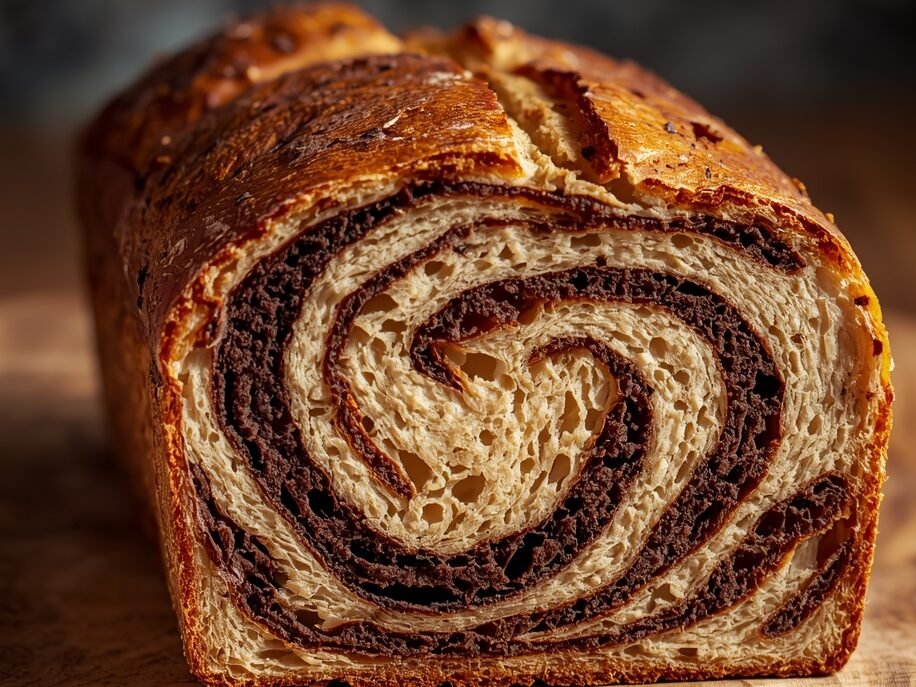
Marble rye bread is a beloved classic—visually striking, richly flavored, and perfect for sandwiches, toast, or just enjoying on its own. Unlike plain rye bread, marble rye features a beautiful swirl of light and dark doughs, combining the mild wheat‑rye flavor with a deeper, more intense rye or pumpernickel swirl.
In this guide, you’ll get:
- A clear, foolproof step‑by‑step recipe
- Expert tips & troubleshooting (swirls, texture, proofing)
- Variations and serving ideas
- Storage, reheating, and pairing suggestions
- SEO‑friendly structure that appeals to readers and search engines alike
By the end, you’ll have a beautiful loaf with contrast, flavor, and texture worthy of #1 rankings.

🧂 Ingredients & Substitutions
Ingredients (for 1 large loaf)
| Ingredient | Amount | Purpose / Notes |
|---|---|---|
| Bread flour | 300 g | Provides strong gluten and structure |
| Rye flour (light or medium) | 150 g | Adds rye flavor, gives body |
| Pumpernickel or dark rye flour | 50 g | Enhances the depth of the dark swirl (optional) |
| Instant yeast | 2¼ tsp (≈ 7 g) | Fast, reliable rise |
| Warm water (≈ 38 °C) | 210–230 g | Hydration, adjust as needed |
| Molasses (or dark honey) | 2 tbsp | Adds sweetness, color, depth |
| Cocoa powder (unsweetened, Dutch processed) | 1 tbsp | For coloring the dark swirl (no cocoa flavor) |
| Sugar | 1 tbsp | Feeds yeast and balances flavor |
| Salt | 1½ tsp | Essential for flavor |
| Optional: caraway seeds | 1 tbsp | Traditional rye flavor |
| Optional: vital wheat gluten | 1 tsp | Helps structure, especially when rye content is high |
Tip: If your rye flour is coarser or stone‑ground, you may need slightly more water.
🛠️ Equipment & Prep Tips
- Large mixing bowls
- Kitchen scale (for accuracy)
- Bench scraper
- Loaf pan (9×5 in or similar)
- Parchment paper or nonstick spray
- Instant-read thermometer
- Cooling rack
Before mixing, proof your yeast (if using active dry) by dissolving in warm water + a pinch of sugar and waiting ~10 minutes until foamy. Though we use instant yeast here, this step can help validate yeast quality.
Step‑by‑Step Instructions
1. Mix the Doughs

- In one bowl, combine bread flour + rye flour + (if using) pumpernickel flour + sugar + salt.
- In another bowl, dissolve molasses in part of the warm water, then split that mixture into two equal portions.
- Add half the flour mix + one portion of the molasses water + yeast to bowl A → this becomes the light dough. Mix to a shaggy mass.
- Add the remaining flour mix + the other molasses water + cocoa powder to bowl B → dark dough. Mix until uniform; adjust water so it feels similar in consistency to light dough.
Why separate? Consistency between doughs is key for a clean swirl. If one is stiff and one slack, the swirl can tear or shift. (Tasting Table)
Let both doughs rest (autolyse) for about 20 minutes before kneading.
2. Kneading & Development
- Knead each dough (by hand or mixer) ~6–8 minutes until smooth and elastic.
- As you knead the dark dough, ensure cocoa is fully incorporated.
- If using caraway seeds, fold them in in the last minute of kneading or during stretch-and-folds.
Windowpane test: grab a small piece and stretch—it should become translucent without tearing.
3. Bulk Fermentation (First Rise)
- Cover both bowls and allow to ferment in a warm, draft-free place until dough doubles (1–1½ hours, depending on room temp).
- Optionally, perform stretch-and-folds at 30 and 60 minutes to build strength.
4. Prepping for Marble Swirl
- After bulk rise, gently deflate doughs and turn them onto a lightly floured surface.
- Roll each into a rectangle of equal dimensions (same size and thickness). Uniform shape is essential for swirl harmony. (Tasting Table)
- Place the dark dough on top of the light dough.
- Roll both together into a log, sealing edges.
- Then twist or fold to create the swirl pattern—be gentle to preserve the layering.
- Pinch the seam, place the loaf seam-side down into the greased pan.
5. Final Proof
- Cover the pan and let it rise until ~80%–90% full, or until a gentle finger press leaves a slight indentation that slowly springs back (~45–60 min).
- If dough begins to get too warm, you may retard it lightly in the fridge for 10–15 minutes.

6. Scoring & Baking
- Preheat the oven to 190–200 °C (≈ 375–400 °F). If using a baking stone, heat it in advance.
- Slash the top with deep cuts (3–5 slits) to allow expansion.
- Optionally brush with egg white or water and sprinkle caraway seeds.
- Bake until the internal temperature reads 90–95 °C (195–205 °F).
- If crust is browning too fast, tent with foil the last 10 minutes.
🎯 Expert Tips & Troubleshooting
Achieving a Clean Swirl
- Match consistency, thickness, and size of both doughs. A mismatch causes slipping or distortion.
- Avoid over-handling—twist gently just enough for visual effect.
- Some bakers chill the log briefly (10 minutes) to help layers set before baking.
Preventing Dense Texture
- Don’t underproof—underproofed rye can be heavy and gummy.
- Don’t overproof—overproofed dough collapses. Use the poke test.
- Use balanced hydration: rye flour absorbs more water than wheat, so err slightly wetter. (recipevalley)
- Add vital wheat gluten if rye ratio is high.
- Use consistent kneading, stretch-and-fold, or fold intervals.
Useful Variations
- Sourdough Marble Rye — combine wild starter + commercial yeast for depth. (Make It Dough)
- No‑knead version — ferment longer and fold to mix. (thefreshloaf.com)
- Molasses‑only swirl (no cocoa) — results in a subtle brown swirl.
- Seeded swirl — include fennel or caraway seeds in the dark dough for aromatic complexity.
🍽 Serving, Storage & Pairings
Serving Suggestions
- Classic Reuben sandwich (corned beef, sauerkraut, Swiss cheese).
- Toast lightly with butter or cream cheese.
- Use for French toast or savory bread pudding.
- Pair with soups (tomato, mushroom, creamy vegetable).
- Pair with strong cheeses like aged cheddar or blue cheese. (ollierecipes.com)

Storage & Freezing
- Room temp: Wrap in a clean towel or store in a breathable bread bag. Avoid plastic directly on crust.
- Freezing: Slice, wrap tightly, freeze up to 3 months. Thaw at room temp or warm in the oven (175 °C, 5–10 min).
- Reheating: Use oven or toaster oven; avoid microwave for full loaf—it changes texture.
Frequently Asked Questions❓
Q: Why add cocoa powder?
Cocoa adds a dark color without strong flavor—commonly used in marble rye recipes for contrast. (King Arthur Baking)
Q: Can I skip caraway seeds?
Yes—you’ll still have good flavor. Caraway is traditional but optional.
Q: Do both doughs rise at the same rate?
Sometimes not. Monitor both and adjust shaping timing so they rise similarly.
Q: Why is mine dense?
Common causes: underproofing, low hydration, mismatched dough strength.
Q: Can I bake this in a bread machine?
Possibly—some machines allow multiple “dough” settings; you’d mix separately and shape manually. (Breadmach)